In 2026 our clients are asking for more drama at the window than we’ve seen in years, and length is a big part of that. But there are also important practical considerations: how you use the room, the space available, your floor levels, the curtain heading, the fabric and lining, and how you plan to open and close your curtains. It is important you think through all of these before making a decision.
What Are The Different Curtain Length Options?
Quick answer: There are five main options. Each has its place, and the right choice depends on your window, your room, the look you want to achieve and practical considerations such as the heading, fabric and lining.
- Sill length: drops to the bottom of the windowsill, or sits just above it
- Below-sill: roughly 10 to 15cm below the windowsill
- Floor length: just touching the floor, or with a clearance of 0.5 to 1cm
- Bounce or break: two to three centimetres longer than just touching
- Puddle: fabric pooling softly on the floor, from 5cm to 30cm or more
Living in a Victorian terrace, an Edwardian house or a flat with floor-to-ceiling glass? Our companion guide, What Curtain Length Suits My Period Home Or London Flat?, takes each type of London home in turn.
When Should I Choose Sill Length Curtains?
Quick answer: In rooms where longer curtains would be impractical, such as kitchens, bathrooms, or windows positioned above fitted furniture.
It is also a natural choice for sheer café curtains that sit within the window reveal. It has a crisp, unfussy quality that works well in more functional spaces.
Check The Pattern Repeat Before You Go Short
When opting for shorter curtains, it’s worth checking pattern repeats. A fabric with a large repeat will look totally distorted and wrong on a short drop.
Similarly, very thick fabrics are best avoided for short drops, as the fabric can end up kicking out at the bottom.
Are Short Curtains Back In Style For 2026?
Quick answer: A few designers think so, but below-sill is a length I’d rarely recommend.
Livingetc’s 2026 bedroom curtain trends feature an American designer championing the return of ‘shorty’ curtains in relaxed bedrooms. I understand the appeal, but below-sill falls into an awkward middle ground: not short enough to feel intentional, not long enough to look elegant.
In most rooms it is worth going one way or the other. Especially in bedrooms, where shorter curtains will compromise blackout and create annoying light chinks.
Katherine’s Key Takeaway
We get asked a lot about curtain length when there’s a radiator below the window. Unless the radiator sticks out too far, I’d always recommend floor length. They look so much more stylish, and they help with blackout, warmth and noise. In the depths of winter most people draw their curtains once the room has heated up, and few have the heating on all night in living rooms or bedrooms.
Should My Curtains Touch The Floor?
Quick answer: Floor length is the gold standard for living rooms, bedrooms, dining rooms, and any space where you want curtains to make a genuine impression. Within floor length there are two options.

For most premium homes, floor length is the default choice. It gives a clean, tailored finish that reads as polished and considered.
Option 1: Just Touching Or Skimming The Floor
In most cases this is what we’d recommend. For bedrooms we would always have the curtains touch the floor, rather than leave a clearance, to prevent any light leakage.
Option 2: A Clearance Of 0.5 To 1cm
There are situations where a clearance is a good idea: kitchens, boot rooms, external doors, or households with pets. Basically, anywhere you may be worried about dust or dirt touching the bottom of the curtains.
This is even more important if the curtains are a light colour, which is often the case with sheer voiles, or for delicate fabrics such as silk, which could be damaged as the fabric rubs along the floor.
What Our Clients Say ★★★★★
Glad I Didn’t Go Online
‘She also works with a really great surveyor and fitter who talks you through the best fit for your particular room and window type; all things I’d never considered... SO glad that I got cold feet about using an online-only curtain and blind supplier, as I would never have measured and fitted them properly!’
Sophie G, Google review
When Just Touching The Floor Doesn’t Work
There are times when we wouldn’t recommend curtains just touching:
- Where floor levels are uneven
- Linen, especially on long drops: the fabric will stretch, so it can be impossible to get a nice, even, crisp hem
- If you’re planning tiebacks: they will draw the curtain up off the floor
In these cases a bounce or puddle will be a much better option.
Katherine’s Key Takeaway
We’d often recommend sheer curtains sit 0.5cm off the floor so the bottoms don’t get discoloured, even if the main curtains are longer. And sheers are well worth considering in 2026: more and more clients are saying yes to sheers as well as their main curtains.
What Is A Bounce Or Break In Curtains?
Quick answer: The curtain is made two to three centimetres longer than just touching, so it bounces or breaks on the floor. We often call this a generous touch.
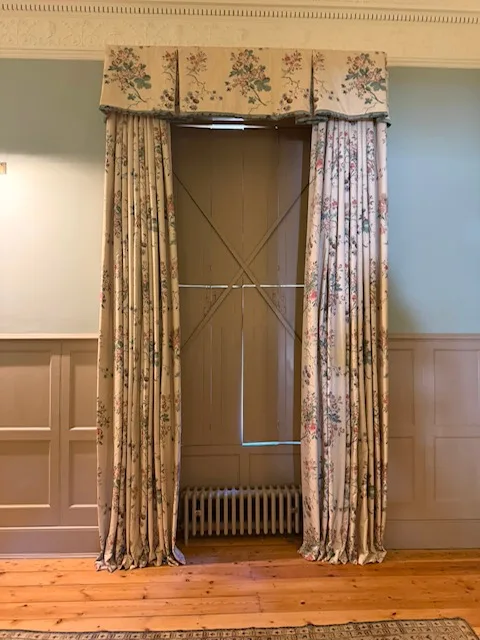
The curtains sit on the floor, but it’s not quite as obvious, or as much excess fabric, as a puddle. A bounce really does suit some interior schemes. Depending on the fabric and heading type, it can look generous and luxurious or give a much more relaxed feel.
When To Avoid A Bounce Or Break
Katherine’s Key Takeaway
We often recommend a bounce or break to hide differences in floor level. It’s also brilliant for linen curtains, especially on very long drops, where the fabric can stretch and getting a crisp, even hem is quite a challenge.
Are Puddled Curtains Back In Style In 2026?
Quick answer: Yes. A puddle takes floor length further, allowing the fabric to pool softly on the floor, and puddled curtains are one of the looks of 2026.
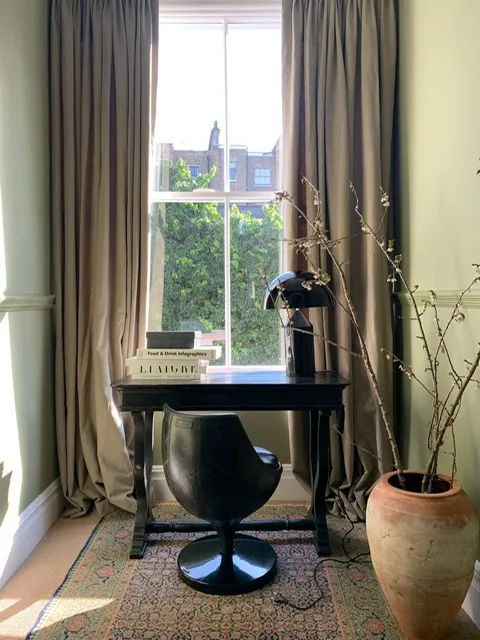
A more generous break of around five to eight centimetres creates an elegant, relaxed look. A true puddle of 20 to 30 centimetres or more creates something much more dramatic and theatrical.
Puddled curtains have enjoyed a real resurgence in recent years, particularly in formal rooms with generous ceiling heights.
We’d recommend a puddle if a client wants that look, but also if the floor levels are way out, which is often the case in older properties.
If you’ve fallen in love with a dramatic tieback, you may want a puddle, so the curtains can be scooped up into the tiebacks without the risk of them rising up off the floor.
There does need to be plenty of space around the window, though. And it’s best if the curtains aren’t opened and closed every day, as this length is more time-consuming to dress.
Katherine’s Key Takeaway
With all of these options, consider the fabric and the heading. Very thick, stiff fabrics work better just touching the floor than in a puddle, which can end up looking too rigid. And if you’re considering shorter curtains, a softer fabric and a simpler heading will stop them bulking and splaying out at the bottom.
What Curtain Length Is In Style For 2026?
Quick answer: Floor length never goes out of fashion. But the gentle break and soft puddle are strongly back, and the move to more dramatic interiors has made generous, trailing curtains feel very much of the moment.
‘People are wanting drama. They’re wanting that whimsical approach. It really is detail plus detail plus detail.’ – Katherine Brown
That’s what I said when we looked at 2026 curtain and blind trends, and length is part of it. Where once a clean, just-clearing hem felt like the only sophisticated option, clients are now embracing more generous window dressings.
Pelmets are back too, framing the top of the window while the fabric falls generously to the floor.
A short break, where the fabric rests softly on the floor, adds a sense of ease and luxury without being overly theatrical. It works particularly well with velvet, linen, and heavier woven fabrics that have a natural weight and drape.
The full puddle remains the choice for rooms designed to impress: a drawing room, a formal dining room, or a principal bedroom where drama is part of the brief.
Can The Right Curtain Length Make A Room Feel Bigger?
Quick answer: Yes, significantly. Longer curtains make rooms feel taller and more generous. Shorter curtains can make a room feel unfinished, or smaller than it is.
One of the most powerful things a curtain can do is change how big a room feels. Hanging your curtains as high as possible and letting them drop to the floor draws the eye upward and makes ceilings feel higher. It is especially effective where the ceiling height is modest.
The designers in ELLE Decor’s guide to curtain lengths agree, suggesting you mount curtains up towards the cornice, or at least halfway between the top of the window frame and the ceiling.
The reverse is also true. A curtain that sits halfway down a wall, or stops awkwardly below the sill, can make a room feel cut off and cramped.
What Our Clients Say ★★★★★
They Really Dress The Rooms
‘She provided me with lots of samples to chose from. We discussed them together and she was a great help in making sure the curtains would really dress the rooms.’
Maud L, Google review
Frequently Asked Questions
Should curtains touch the floor or stop just above it?
For living rooms, touching or very slightly clearing the floor is almost always the more elegant choice. For bedrooms it’s best to have the curtains touching the floor, as this will give superior blackout.
Is a puddle of fabric on the floor practical?
It works best in rooms where the curtains are opened and closed infrequently, such as a formal drawing room or dining room. In high-traffic areas, or if you have pets or young children, a just-clearing hem or a slight bounce is more practical.
What if my floors aren’t level?
This is very common in period properties. A bounce or puddle can really help to disguise the difference.
Can I have different curtain lengths in different rooms?
Absolutely. The length should respond to the room, the window, and how the space is used. A consistent heading style or hardware finish still creates a sense of flow across the house.
Does curtain length affect the price?
Yes. Longer curtains need more fabric. A puddle or generous break will add a little to the overall fabric cost, but it’s not a great deal.