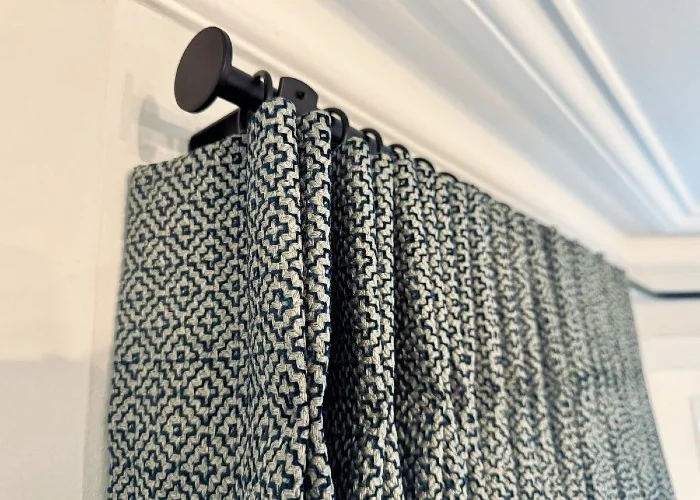
Why Does The Curtain Heading Matter So Much?
Quick answer: The heading decides how far your curtains open, how well they keep out the light, and how your fabric hangs. Get it right and even a less premium fabric can look really quite special.
Blocked Windows
Have you ever wanted to open your curtains that bit wider? You’ve got a lovely view, but so much of it is blocked by the bulk of the curtains, even once they are fully opened. It’s not an uncommon frustration, and it has a very simple cause: the wrong heading type has been used. If you are still weighing up the curtain itself rather than the heading, see every type of curtain we make.
Blackout Is Compromised
A common issue occurs when the curtain heading is not taken into consideration when planning for blackout. You may love eyelet or wave curtains, but if you are light sensitive, they are not ideal, as there will be light seepage at the top and the bottom.
The Opportunity To Amplify Your Curtain Design
Getting your curtain heading right offers a huge opportunity to take your end result from average to fabulous. The perfect heading will make sure you get every penny of value from an expensive fabric.
Katherine’s Key Takeaway
For very long curtain drops, consider making your heading deeper. A much longer double pinch pleat will look super elegant and dramatic.
Watch: Katherine On When Pencil Pleat Works, And When It Doesn’t (2 Minutes)
Read the video transcript
Pencil pleat is a very common curtain heading. It has its pros, and it also has its cons.
We get a lot of people coming to us, maybe they’ve made their own curtains in the past, and maybe it’s the heading that they’ve heard people talk about, so they’ll ask us for a pencil pleat heading.
We tend to avoid pencil pleat headings on curtains that are going to be opened and closed. And the reason we do that is because the nature of a pencil pleat heading is that it uses heading tape applied to the back of the fabric, with strings that are used to draw the fabric together.
So what that means is, for curtains where you’re perhaps framing a beautiful window, the curtains don’t stack back terribly well. They don’t have the structure of, say, a double pinch pleat curtain.
But we do use pencil pleat quite often in certain applications. And where a pencil pleat works really well is on curtains that you’re keeping closed.
So for example, sheer curtains. But the important thing there is to make them really full, so that you see lots of the little cylindrical shapes that are formed by the gathers.
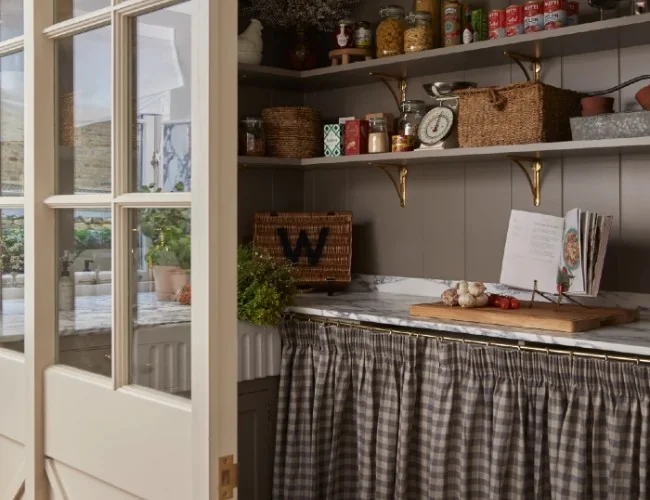
The other place pencil pleat works really well is on things like little café curtains, for pantries or utility areas, where most of the time those curtains are closed and you don’t need them to stack back.
How Do I Choose The Right Curtain Heading?
Quick answer: Start with four things: your fabric, the length of your curtains, the space they have to stack back into, and the hardware they will hang from.
Fabric Type
Consider the thickness of your fabric. With a thicker fabric, it is best to choose headings with less gather, whereas a lighter-weight fabric might suit a more gathered look. If your fabric has a big pattern, you may want fewer gathers so that you can see more of the pattern. Conversely, smaller, denser patterns may suit a more gathered look.
Length Of Curtains
For shorter curtains, it is best to avoid pencil pleat and triple pinch pleat, as making the curtains too gathered can result in them splaying out at the bottom. For more on getting the drop right, see how long your curtains should be.
Available Space
It is important to choose the right heading to suit the stacking space you have available. If fitting curtains inside a recess, you will want a heading that offers very efficient stacking. If you’re having two layers of curtains, for example voiles and blackout curtains, you need to consider the space at the front and back to ensure the curtains operate freely.
Hardware
If you’re using existing hardware, or have no choice for some other reason, that may well dictate the heading you can have. If you are still deciding, see curtain tracks or poles.
Every heading here is one we make by hand: see our made to measure curtains page for how measuring and fitting work, and real prices from recent projects.
What Our Clients Say ★★★★★
Beautifully Made And Expertly Hung
‘Chris came and advised re poles & tracks, including tricky bays where others had said I could only have blinds. The finished product is fantastic, beautifully made and expertly hung.’
Kristina F, Google review
Become our next happy client →
What Are The 9 Curtain Heading Types?
Quick answer: Pencil pleat, cottage, single pinch pleat, double pinch pleat, triple pinch pleat, Euro pleat, wave, eyelet and tab top. For most curtains that are opened and closed every day, the double pinch pleat is my go-to.
What Is A Pencil Pleat Heading?
Pencil pleat curtains are made by sewing a tape with strings to the inside top of the curtain. These strings are pulled to gather the curtains to the desired width. This creates semi-cylindrical folds which look like a neat row of pencils, hence the name. Pencil pleat curtains can go on tracks or poles.
For medium-weight and lined curtains, this heading can simply result in too much bunching and bulk, and curtains that are difficult to stack back off the windows: hence that frustrating blocked view I mentioned earlier.
Katherine’s Key Takeaway
We get asked for pencil pleat an awful lot, because it’s the pleat everyone seems to be most familiar with. But there are a number of applications where it is just not suitable.
That said, there is one application where pencil pleats work very well: small café curtains, typically for a pantry or small window. Here, the combination of a small curtain and light material makes pencil pleats a great option.
What Is A Cottage Heading?
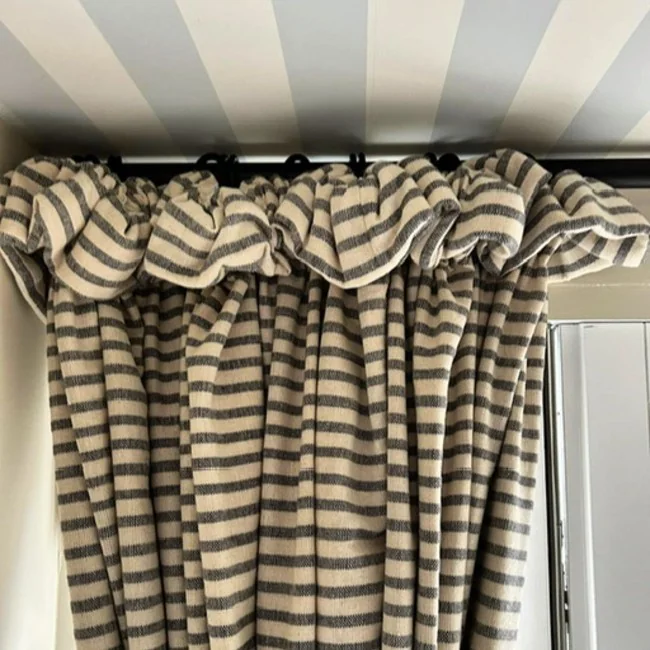
Cottage heading, otherwise known as a gathered pleat, gives a casual, informal look. A narrow pencil pleat tape gathers the curtains into soft folds. Add an upstand with extra lining inside and you get a stunning ruffle top heading, especially good if you are after a vintage look. It’s a really fun feature that looks great where you want to make a statement, such as in a cottage or a children’s bedroom.
What Is A Single Pinch Pleat?
Single pinch pleat curtains are made by creating a single fold at the top of the curtain, evenly spaced and separated by flat sections of fabric. This is a modern heading style which stacks really well and can be a very sensible choice for many applications. In my opinion, though, it can sometimes lack the stunning neatness and structure of a double pinch pleat.
Some people like a more relaxed look where the heading is a little less regimented, and here a single pinch pleat works very well. It is also a good choice if you are on a budget, as it may need a little less fabric than other pleats.
In our experience, a single pinch pleat works better on a track or pole, and less well with a covered lath, where the pleats can end up looking quite messy. It also works better on wider windows than on smaller ones, where you may only get a few pleats.
What Is A Double Pinch Pleat?
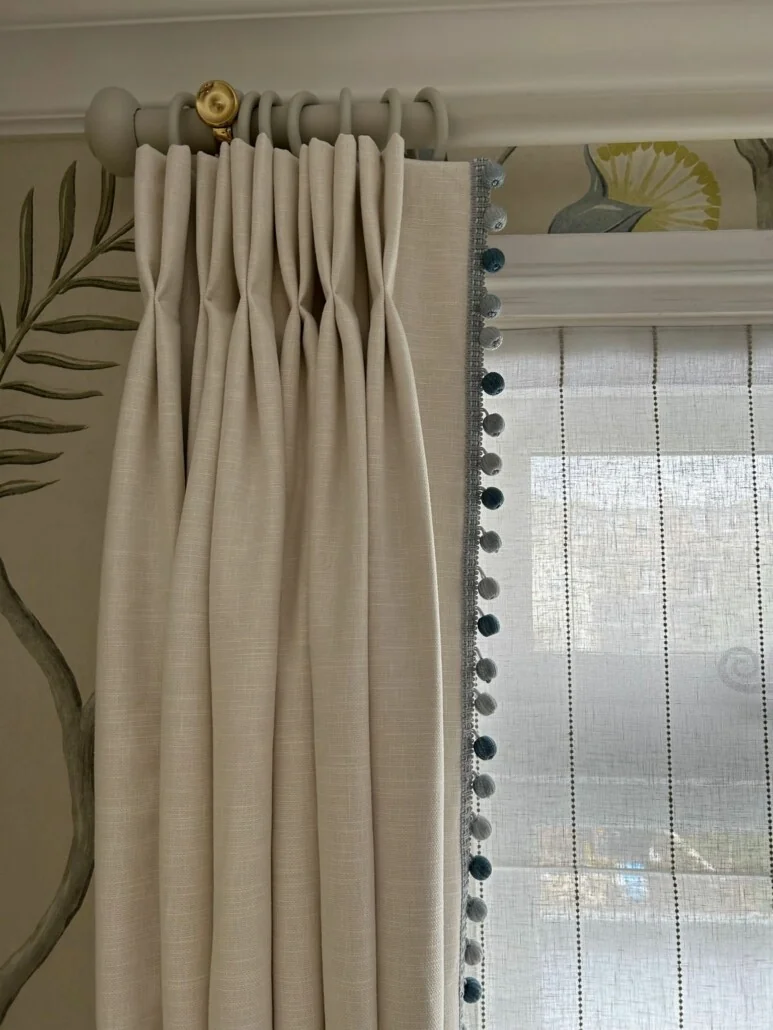
Double pinch pleat curtains are made by creating a double fold at the top of the curtain, evenly spaced and separated by flat sections of fabric. These headings work well in both contemporary and traditional settings.
The double pinch pleat is our go-to heading. We love it because it is structured, elegant and neat, and it looks good open and closed.
Double pinch pleats are nice and easy to live with, and are brilliant for lined or unlined curtains. There is nothing nicer than full-length sheer curtains with a double pinch pleat heading.
Watch: Katherine On Why Double Pinch Pleat Is Her Favourite Heading (1 Minute)
Read the video transcript
A trend that won’t ever go out of style, and I would hate it to go out of style, is the double pinch pleat heading. It’s my favourite heading in most scenarios, because it is neat, it’s elegant, and it adds structure to fabric.
I also love the flexibility of a double pinch pleat, especially where you’ve got very high ceilings, because we can make the pleats longer. So if, for example, you’ve got a three-metre drop to your curtains, a double pinch pleat is excellent, because we can make those pleats that bit longer, which gives more structure to the curtain.
So it’s a bit of a go-to, a bit of a favourite of mine. Double pinch pleat.
What Is A Triple Pinch Pleat?
As a progression from single and double pinch pleats, a triple pinch simply uses three pinches separated by a flat piece of fabric. It uses more fabric and therefore has more volume, which can be too much on smaller windows. We use these less often these days, but when we do, it is usually where the setting is much more traditional or luxurious, often in properties with bigger windows.
What Is A Euro Pleat?
A modern version of a pinch pleat, where the fabric is pinched at the top of the curtain rather than lower down. It suits settings that need the structure of a double pinch pleat but want it to look a bit more modern or relaxed.
What Is A Wave Heading?
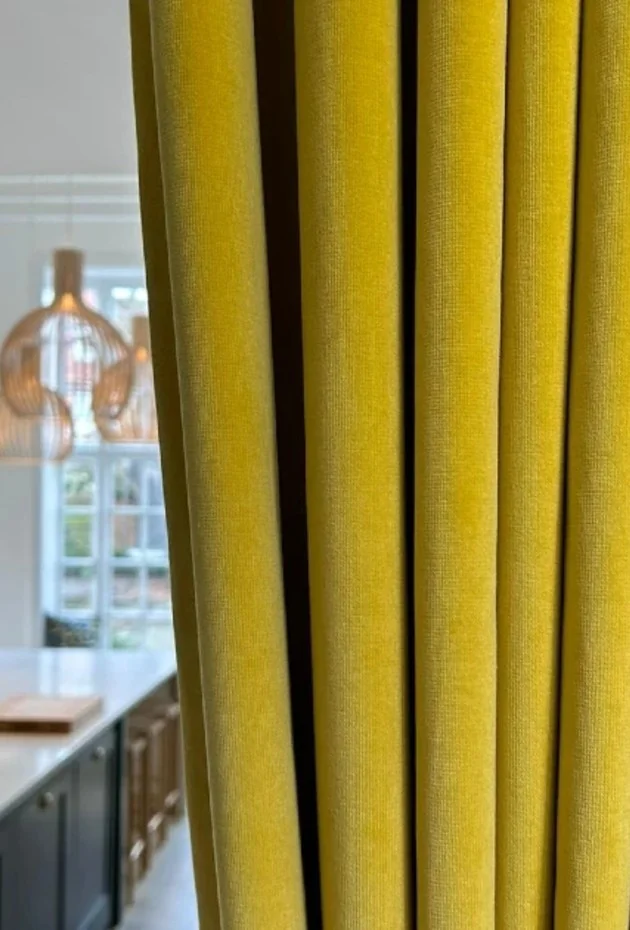
Wave is a very contemporary curtain heading that creates a continuous, flowing wave effect. It is achieved with a special flat tape sewn into the top of the curtain, which, used with a special track, allows the fabric to form a very soft wave shape. It gives a very clean, modern look. We often use this heading on double-sided room dividers, where you can hide the tape between two pieces of fabric.
Katherine’s Key Takeaway
Wave curtains don’t stack back as compactly as people expect, because of the gliders the heading needs. Estimate the stack-back size before you commit.
What Is An Eyelet Heading?
Metal rings called eyelets are punched into the top of the curtain, and the fabric is threaded onto the pole to create soft, even folds. It is a simple approach, often found in ready-made curtains, as it does not need hooks or rings. It is less popular for bespoke curtains because it doesn’t suit larger windows, can be difficult to open and close, and isn’t very good for blackout. We’ve seen a big decline in its popularity because of those issues, and fashion seems to have moved on a bit too.
What Is A Tab Top Heading?
The curtain hangs on a pole threaded through a series of loops sewn onto the top of the panel, giving a casual, relaxed look. Tab tops are for dress curtains, or café curtains that don’t need to be opened.
What Our Clients Say ★★★★★
We Felt Confident Making Our Choices
‘She took the time to understand what we needed and provided advice and options without pushing us to any particular approach. Her expertise in curtain design, as well as the beautiful fabrics she recommended meant that we felt confident making our choices.’
Jemma W, Google review
Become our next happy client →
Pencil Pleat Vs Pinch Pleat: Which Should I Choose?
Quick answer: For curtains you open and close every day, choose a double pinch pleat. Pencil pleat is best kept for curtains that mostly stay closed, such as sheers and café curtains.
This is the comparison we’re asked about most. Pencil pleat is the familiar, economical choice: a string-gathered tape creates neat cylindrical folds, and it works on tracks or poles. But it doesn’t stack back well, so it suits sheers and café curtains far better than main curtains. Pinch pleat is the tailored upgrade: each pleat is sewn in permanently, so the curtain hangs in structured, even columns that look as good open as closed.
My verdict: if you want handmade curtains to look their absolute best, choose a double pinch pleat. Choose a triple pinch pleat for grand, traditional rooms with bigger windows, where the extra fullness earns its keep.
Frequently Asked Questions
What is the most popular curtain heading?
Pencil pleat is the one most people ask for, because it’s the most familiar. For bespoke curtains that are opened and closed every day, the double pinch pleat is our go-to.
Are eyelet or wave curtains good for blackout?
Not ideally. Both let light seep in at the top and the bottom, so if you are light sensitive, plan the heading and the blackout together.
Which curtain heading uses the least fabric?
A single pinch pleat may need a little less fabric than other pleats, so it is a good choice on a budget. A triple pinch pleat uses the most.
Which curtain heading is best for a small window or recess?
Choose a heading that stacks back very efficiently. Avoid triple pinch pleats, which can be too full for smaller windows, and bear in mind a single pinch pleat looks best on wider windows, where you get more pleats.