Curtain Tracks or Poles- Which Is Right for Your Home?

Curtain Tracks or Poles: Which Is Right for Your Home?

You jumped into fabrics and finishes, right? Don’t worry – everyone does when they set out on a window dressing project. I’m here to share how to get an expert finish and have a lot less stress along the way:  Start with hardware – that’s tracks and poles – and you’ll be rewarded with the finished look you dreamed of (and it won’t be blighted by last-minute hardware snags).

Forget Fabrics (For Now): Why Curtain Hardware Comes First!

Thinking about curtain hardware shouldn’t just be done at the start of your window dressing journey, but should be happening well before it. Thinking of a significant renovation or even building a home from scratch? Start thinking about curtain hardware early, and you will be rewarded beyond your wildest expectations.

Naturally, for most, you won’t have the luxury of a complete blank canvas, and that’s fine – read on to learn how to choose the best curtain hardware for your home, and the dramatic impact this can have on your window aesthetic and function.

How Curtain Experts Really Choose Hardware

As curtain experts, we are advising clients on curtain hardware all the time, and if you’re planning your project or want to be fully prepared for a consultation with your curtain designer, here are some key considerations to keep in mind:

1. Style – Do you have an aesthetic preference that would lead you naturally to choose one over the other? Clean lines and simplicity – go for a track. Drama and character would probably mean a pole.

2. Function – Start at the beginning! What do these curtains need to do for you? Is it purely privacy? Is blackout essential? How important is warmth and thermal insulation? Or are they more decorative than anything else?

3. Operation –  How do you want to open and close your curtains? Happy to open them by hand or with draw rods? Do you prefer a corded track or pole? Or does motorisation sound like a ‘must-have’?

4. Reality of space – What is feasible for your windows? Consider the space around the window to fit hardware and your ability to make structural changes to accommodate or conceal curtain hardware.

READ: 11 Essential Trends for 2025

1. Style – Rules are made to be broken – sometimes!

First, let’s clarify the ‘rules,’ then we’ll discuss breaking them. Generally, a contemporary, new-build apartment is likely to suit the look of tracks. The enviable floor-to-ceiling windows that characterise these apartments often mean there’s limited space above the windows for curtain hardware.

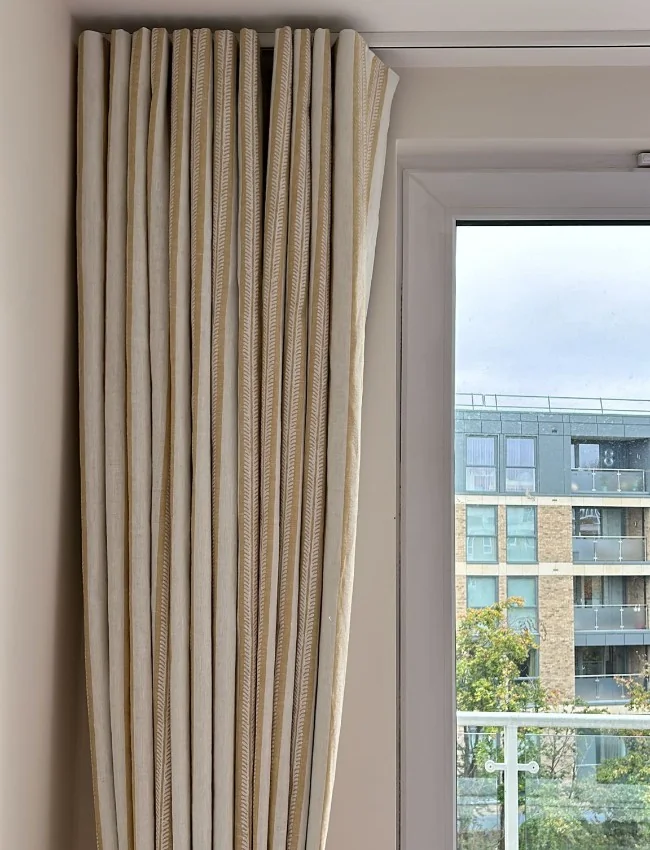
Full-length curtains on ceiling fixed or recessed tracks offer the cleanest, most architectural solution, with tracks disappearing into the ceiling, creating the illusion that the curtains float effortlessly in the space.

Full-height curtains on tracks in a designer flat can help accentuate the ceiling height and are much more in tune with the overall aesthetic.

On the other hand, period homes and especially their main ‘feature’ windows, often suit poles better. But saying that, a modern extension to a period property may suit the tracks better. The reality is that most homes would have a combination of poles and tracks, depending on the room and window.

READ: Bespoke Curtain Designs for Contemporary London Flats

READ: Blinds for Victorian and Edwardian Homes

Ok, so now let’s look at the way we can break these rules

When it comes to curtain tracks or poles, the idea that period homes cannot accommodate tracks is a huge oversimplification – a major disservice to the trusty and incredibly versatile curtain track!

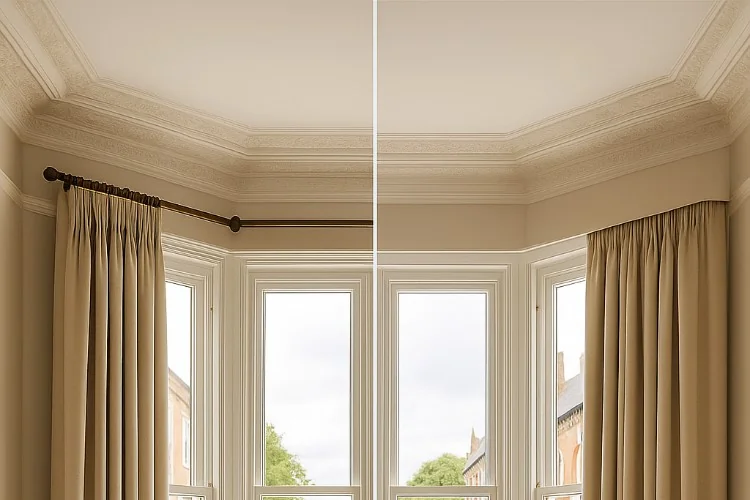
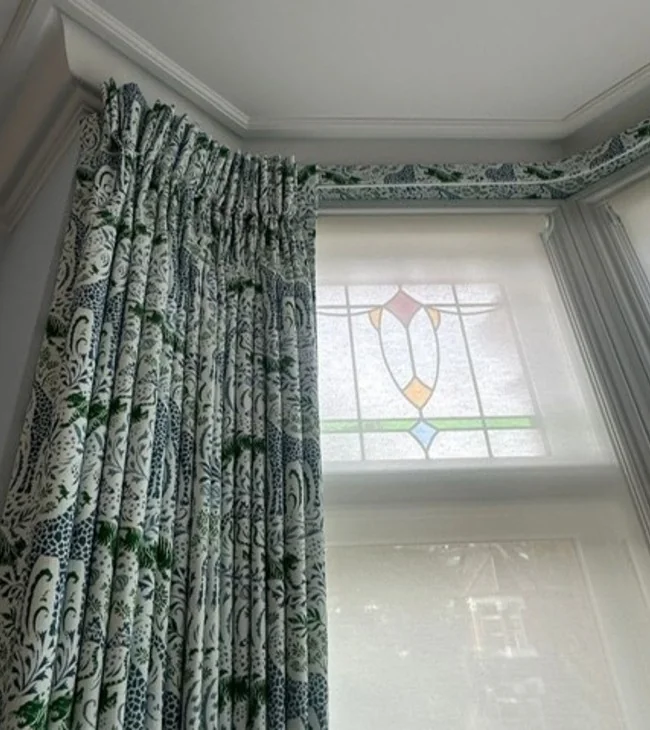
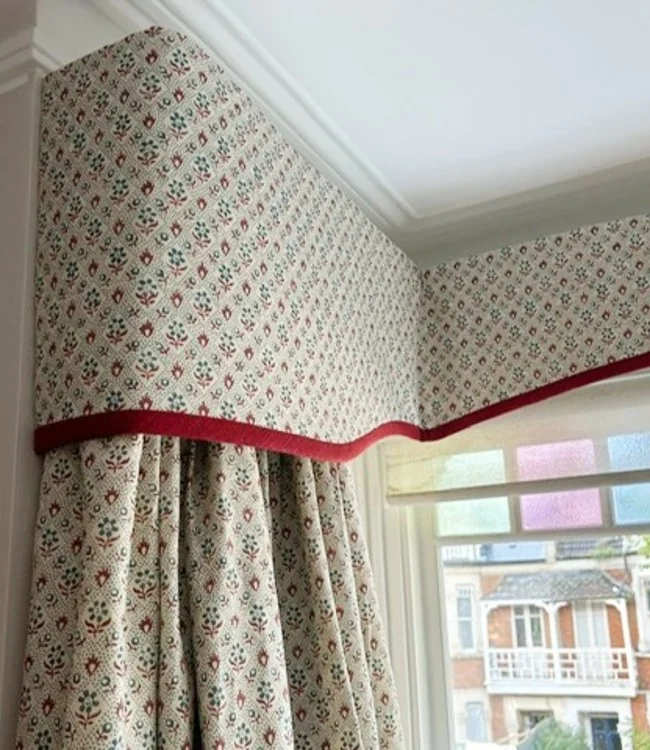
There are numerous ways to utilise tracks in both contemporary and period properties in a sympathetic manner: We can recess tracks in the ceiling so they disappear entirely, put them behind decorative cornicing or pelmets, cover them with a lath and fascia, or ceiling mount or face-fix them. 

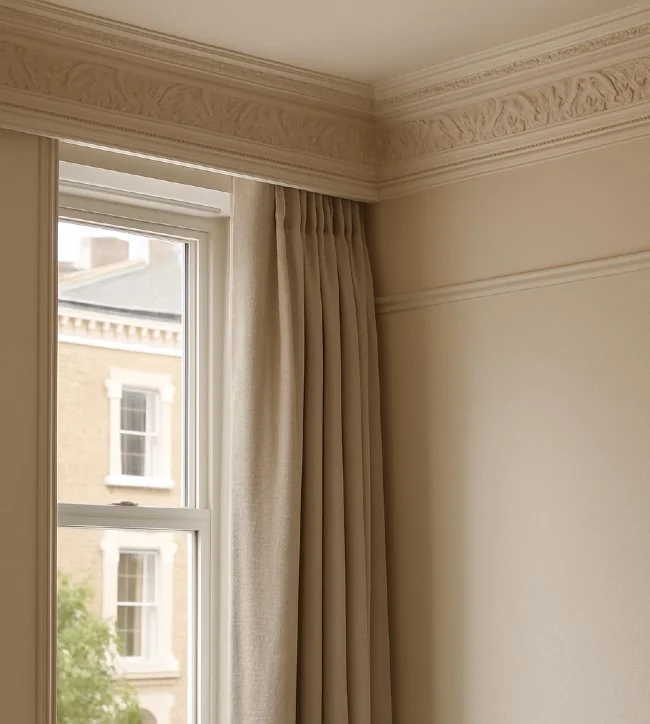
If you are renovating a period home, a stunning feature we often recommend is to set the cornice forward to create a recess to hide the curtain tracks, giving you the performance of a corded curtain track with the drama of full-length curtains that appear to float from the ceiling.

Incidentally, that is why it is so essential to consider tracks vs poles early on in your renovation project. In the case above, the work was done as part of a renovation project, where it was easily included thanks to good forward thinking.

Katherine’s Key Takeaway: Tracks are not just for sleek penthouses – they can work wonderfully in your period home, cottage or farmhouse, especially if you are open to creative ways to position and conceal.

2. Function: What Do You Actually Need Your Curtains To Do?

Don’t go too far along with hardware choices until you’re clear on what the window dressing needs to do, especially if it’s for a bedroom and you need blackout. You then need to consider your specific blackout needs – for example, do you need complete darkness or do you prefer to wake up naturally with some daylight creeping in?

Want a proper blackout? Then, tracks are the answer

If you need complete blackout then the best hardware options are corded tracks with an overlap arm combined with a pelmet or a covered lath and fascia. If you prefer the look of a curtain pole then you will either have to accept some light leakage over the top or invest in a secondary blackout window treatment such as a zipped blackout blind.

Don’t mind a bit of light? Then your options increase

If your curtains are for privacy, insulation and/or decoration then your hardware options are wider and more likely to be based on aesthetics, feasibility or operation.
Where window dressings are simply there to complete the look of your space, it may well be that poles are better because they can look more considered and offer so many ways to customise, offering a great opportunity for a serious style statement of their own.

Katherine’s Key Takeaway 
There are so many stylish, quality poles on the market to suit all budgets – we especially like Cameron Fuller, The Bradley Collection, Byron and Byron and Tillys Interiors.  

Cameron Fuller

The Bradley Collection

Byron and Byron

Tilleys Interiors

3. Operation – How Will You Open And Close Your Curtains? (And How Often?)

How you would like to open and close your curtains will depend on personal preference along with some more practical considerations.

Do you prefer an un-corded, corded or motorised operation? You may have a preference based on past experience, or it may be something you haven’t ever thought of.

It may come down to practical considerations, such as the size and style of the window.

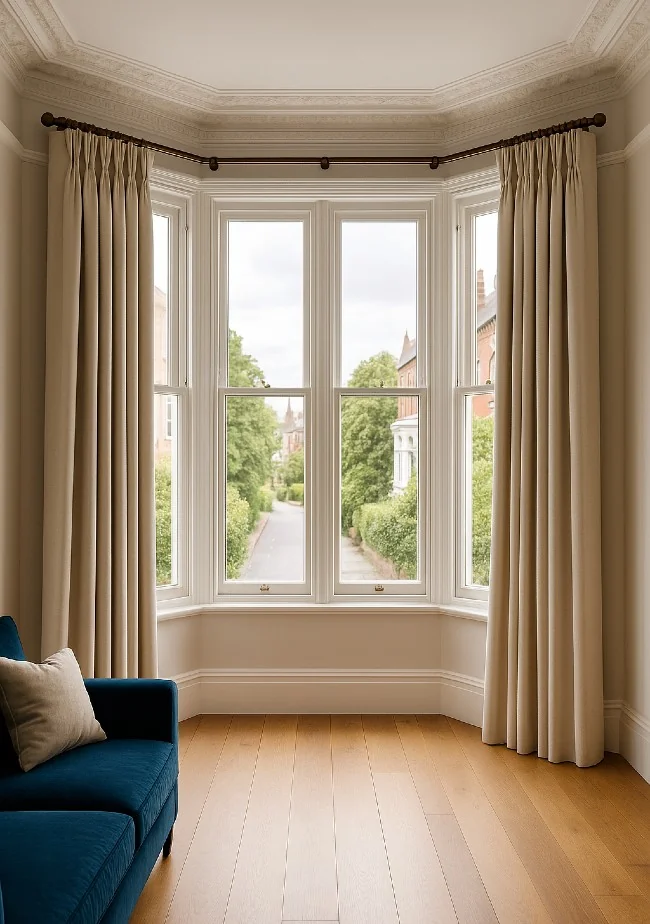
For example, corded tracks and poles can be a wise choice for a large bay window, especially if it is also difficult to access, like when furniture is in the bay. It is often advisable to have bay tracks corded on both sides, especially if the curtains are very heavy.

Which room are the curtains in and how often will you be opening and closing them?

For example in a bedroom where curtains are regularly opened and closed a corded or motorised operation may be beneficial and means that you aren’t touching the fabric each time, which over time will leave marks on the fabric.

The mobility of the user is another important factor and may mean that corded or motorised options are more convenient and safer than hand-operated options.
How much flexibility you need with curtain configuration should also be considered. For example, if you are dressing a set of full-width bi-fold doors it may be advantageous to have an un-corded track so that the curtains can be dressed either as a pair or can all be stacked on one side when the doors are fully open so that they don’t get in the way. Thinking this through at the planning stage will pay dividends in the long run.

4. Your Space -What Will Actually Fit?

We are now ready to consider the feasibility of achieving your ideal hardware scenario and so we now need to think like a curtain fitter. We need to assess the wall and ceiling space we have available around the window to determine whether a pole or track is more suited and where it will be best positioned – either face fixed on the wall above or top fixed to the ceiling.

  • Is there cornicing on the ceiling and above the window which will prevent us from ceiling mounting hardware?
  • Do we have sufficient space above and to the sides of the window for the supporting brackets which need a nice strong flat surface to mount to?

If you are renovating your home, then now is the perfect time to bring in an expert to help you plan ahead for your window dressing hardware, so that you don’t make decisions on architraves and cornicing that prevent you from achieving your vision later down the track. Contact Katherine Brown

Tracks: The Designer’s Secret

If you’re looking for understated elegance, curtain tracks are your best friend. Hidden tracks allow your fabric to take centre stage—no interruptions, no visual noise. This is particularly effective when your curtain fabric is the star of the show, or when you want to create a serene, minimalist interior.

Why choose tracks?

Clean lines: Tracks are perfect for layered looks—voiles and lined curtains—without drawing attention to the mechanics.
Wave headers: Tracks allow for a smooth, even wave heading, which glides effortlessly and creates a polished, hotel-style finish.
Bay windows & awkward spaces: Custom-bent tracks follow curves seamlessly, making them ideal for Victorian bays or quirky Edwardian angles.
Ceiling mounting: For a more dramatic, full-height feel, tracks can be installed on the ceiling, elongating the room and emphasising the height of your windows.

Katherine’s Key Takeaway: tracks let the fabric speak—ideal for clients who value understated luxury and architectural flow.

Poles: The Decorative Statement

Poles are a classic choice, especially in period homes where detail and character are king. If you’ve gone to the effort of selecting a stunning finial or you want to complement other fittings—like brass handles or iron fireplaces—a pole can be a beautiful addition.

Why choose poles?

  • Aesthetic impact: Poles can be matched to architectural features—think antique brass in a Victorian living room or brushed nickel in a modern apartment.
  • Finials as jewellery: Much like a great necklace finishes an outfit, a finial can dress your window with personality and flair.
    Architectural positioning: Poles work best where there is plenty of wall space above the window – position the pole high above the window to add drama and elegance and to draw attention to a beautiful view.
  • Layered design: A pole over a roman blind? Classic. Especially effective in children’s rooms, home offices, or where you need privacy and softness combined.

Poles offer structure and symmetry, and when chosen well, they echo your home’s character in the most intentional way.

At Katherine Brown Curtains and Blinds, it’s ‘Function First, Beauty Always’ – we believe every design decision should begin with what you want your window dressing to achieve and end with how you want to feel.

Our service will guide you to the perfect combination—whether that’s a discreet wave track that vanishes into your ceiling, or a beautifully hand-finished pole that draws the eye upward. Always fabulous, never average!

Get the look