best blackout for your bedroom windows

Blackout Curtains And Blinds For The Bedroom: How To Achieve Total Darkness Without Losing Style

Light leaking into your bedroom at dawn can disrupt your sleep before your alarm even goes off. If you have tried standard curtains or blinds and still find yourself waking too early, the problem is almost certainly one of fit, installation, or the wrong product for your window. This guide draws on the expertise of bespoke curtain and blind designer Katherine Brown to walk you through every option for achieving genuine blackout in your bedroom, the honest trade-offs between different approaches, and how to make your windows look beautiful in the process. By the end, you will know exactly which solution suits your windows, your budget, and the home you want to live in.

Bedroom Blackout For Healthy Living.

Light and sleep have a more complex relationship than most people realise. A study of over 400,000 UK adults by UK Biobank found that time spent outside in natural daylight is directly linked to better mood, fewer insomnia symptoms, and a well-regulated circadian rhythm. Yet the same study found that around 6.69% of UK adults report being disturbed by light when trying to sleep or in the early hours, and that this disruption can push the body’s internal clock out of sync with the natural day-night cycle. That is roughly one in every 15 people in Britain.

The best bedroom window treatment, then, is not simply the one that blocks the most light. It is the one that gives you full control: open and welcoming during the day, completely sealed at night.

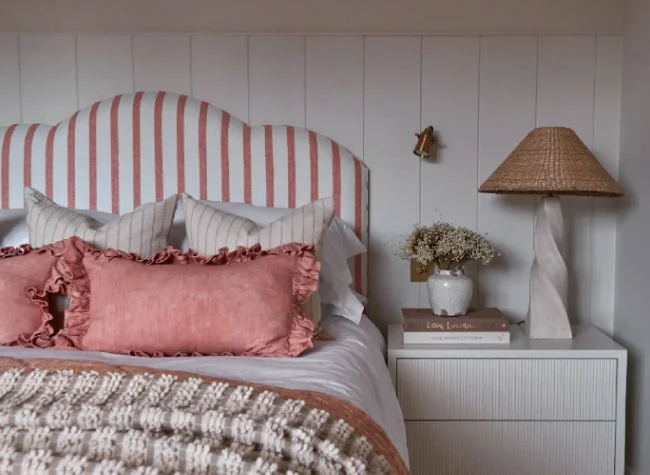
Creating a cosy environment will do wonders for your sleep

How Much Blackout Do You Actually Need In Your Bedroom?

Quick Answer: This depends on your sensitivity to light and how the bedroom is used. Complete blackout is essential for some people, but for others, a little light creeping in is perfectly fine.

Katherine says one of the most common misconceptions she encounters is the assumption that a blackout-lined curtain will automatically deliver 100% blackout. In her experience, it will not, because the lining is only part of the equation. Hardware matters just as much.

Hardware choice is key

When a client tells her they need total blackout, she asks a simple follow-up: do they also want a curtain pole? If the answer is yes, she is direct with them. A pole will not give 100% blackout, because light behaves like water and will find any gap to escape through, whether that is above the pole, between the rings, or at the sides. If true blackout is non-negotiable, it rules out poles and requires a corded track, covered lath and fascia, or pelmet instead.

What tends to happen next, she says, is that clients surprise themselves. Once they understand the trade-off, many of them step back from the 100% position. ‘Actually,’ she hears regularly, ‘I don’t mind being woken up at six in the morning when it’s a beautiful summer day.’ Knowing what you actually want before committing to a solution saves both money and disappointment.

Katherine’s Key Takeout: Just because a curtain says it is blackout lined does not mean it will give you 100% blackout. The lining helps, but if light can escape over the top or down the sides, it will. Hardware is as important as lining when blackout really matters.

pelmet helps blackout curtains

Which Is Better For Bedroom Blackout: Curtains Or Blinds?

Quick Answer: Full-length blackout-lined curtains on a corded track, combined with a covered lath and fascia, or pelmet, will give you the best blackout in most situations. But the right answer depends on your window type, room layout, and how much wall space you have to work with.

In most cases, full-length curtains on a corded track give you the greatest blackout potential. The key is to extend them well beyond the window frame on each side so no light creeps in at the edges, and to hang them as high as possible above the window.

Blinds come into their own for smaller windows, or in rooms where full curtains would overwhelm the space.

Roman blinds are elegant but do allow some light at the sides, so they work best when the bed is positioned away from the direct line of the window.

Blackout roller blinds are particularly effective when fitted inside a window recess.

Will A Curtain Track Or Pole Give Me Better Blackout?

Quick Answer: A corded track will always outperform a pole for blackout, because the curtains can overlap at the centre and sit flush to the wall at the sides.

A curtain pole, while often more stylish, creates unavoidable gaps. Light enters at the top between the rings and the pole, and at the sides where the curtains do not quite reach the wall. If you love the look of a pole, position it as high as possible above the window and consider a glider pole, where curtains run on a track inside the pole rather than on rings. This closes the gap at the top considerably.

Read our guide to Curtain Tracks Vs Poles here.

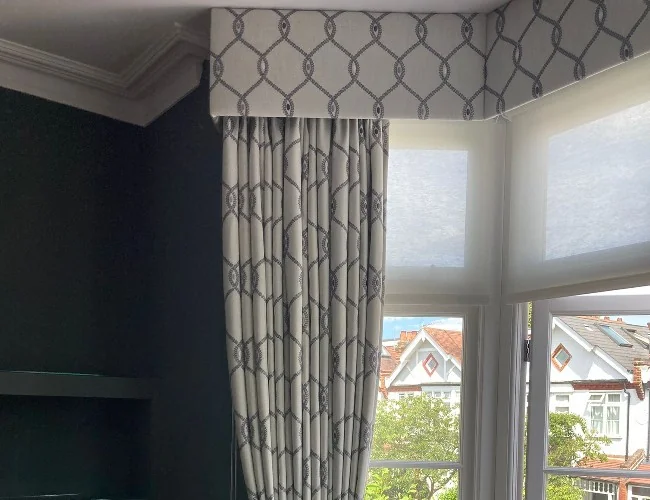
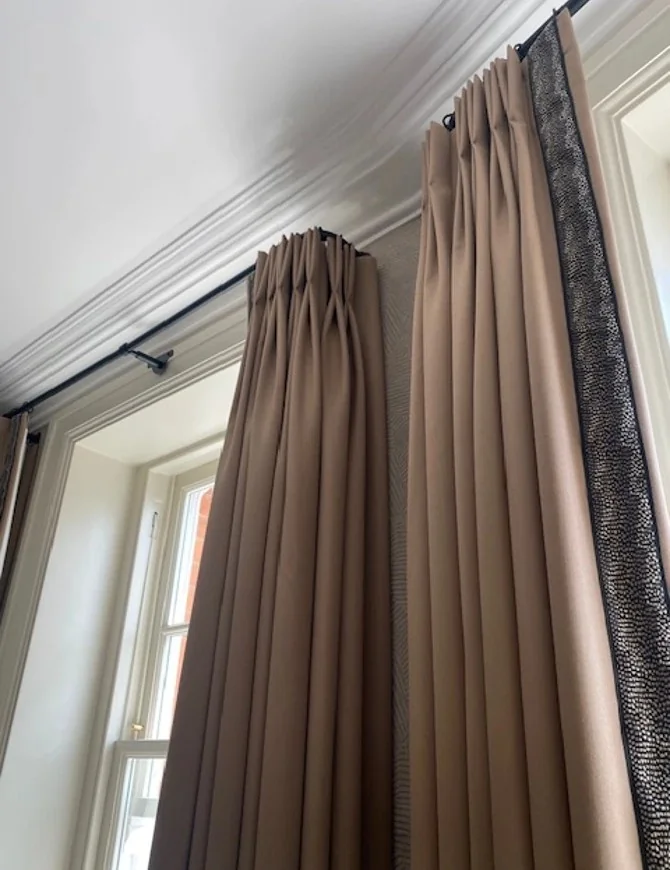
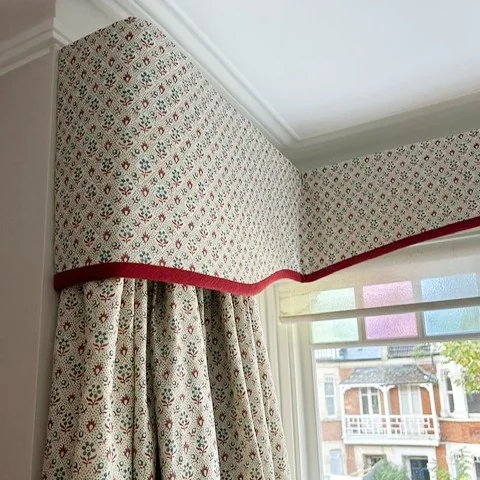
For maximum blackout, a corded track combined with a covered lath and fascia or pelmet is the gold standard. The covered lath closes off the space between the top of the curtain and the ceiling, which is exactly where most residual light enters.

Katherine’s Key Takeout: Covered laths and pelmets do more than hide your track. They seal the gap between the top of the curtain and the ceiling, which is where light sneaks in even on the best-fitted curtains. If blackout is a priority, they are well worth the investment.

Notting Hill curtain maker

What If I Have a Radiator Under My Window?

Quick Answer: A deep radiator pushes your curtains forward and creates a gap at the top of the window. A covered lath and fascia is the best solution in this situation.

Katherine explains that when a curtain pole is used above a radiator, the brackets have to project the pole out far enough to clear the heat source, which pulls the curtains away from the wall and opens up a gap at the top. Some clients choose to use standard projection brackets and simply pull the curtains manually in front of the radiator at night, accepting that the look when closed is less neat. For others, that is a perfectly reasonable compromise.

If blackout is the priority, though, Katherine’s preferred solution is a covered lath and fascia. The board can be made as deep as needed to clear the radiator, and crucially, it closes off the space at the top so that no light seeps over. It is, she says, the very best option in this scenario.

What Is the Best Blackout Solution for Dormer Windows?

Quick Answer: For most dormer windows, a blackout-lined Roman blind is the most practical and effective option.

Katherine’s reasoning is straightforward. In a dormer, the walls either side of the window recess do a lot of the work that curtains would otherwise struggle with: they contain the light and eliminate the side-leakage problem that Roman blinds experience on standard flat walls. Curtains, on the other hand, tend to take up too much of the limited space available in a dormer.

The exception would be if the curtains could be fixed to the side walls rather than the window frame. But in many dormers, those walls slope, which rules that out as a practical option.

Katherine’s Key Takeout: A dormer window is one of the few situations where a Roman blind will actually outperform curtains for blackout, because the recess walls solve the light-leakage problem that Roman blinds face on flat walls.

curtain and blind cost factors

Does The Colour Or Type Of Fabric Affect How Well Blackout Works?

Quick Answer: No. The lining does the work, not the face fabric. A pale, lightweight fabric with a blackout lining will perform just as well as a heavy, dark one.

A common misconception is that dark or heavy fabrics provide better blackout on their own. In reality, a lightweight fabric with a proper blackout lining will perform identically to a heavy charcoal velvet. This means there is no need to choose between a fabric you love and good blackout performance.

What about curtain lining grades? Do they matter?

This is a question Katherine is asked regularly, and her answer is refreshingly direct: not really. There are different grades of blackout lining available, and you will find no shortage of retailers suggesting that the premium option makes a meaningful difference. In Katherine’s professional experience, the standard blackout lining does the job. The marginal gains from an upgraded grade are not something her clients notice in practice, and she would rather be honest about that than have someone spend money unnecessarily. The hardware, the installation, and the heading choice will have far more impact on your blackout result than the grade of lining behind the fabric.

Katherine’s Key Takeout: Do not get drawn into spending more on premium blackout lining grades. A standard blackout lining works. Put your budget into the right hardware and a heading that stacks properly, and you will get far better results.

Can I Use Both Curtains and Blinds Together for Maximum Blackout?

Quick Answer: Yes, and it is one of Katherine’s most recommended combinations. The blind handles the darkness; the curtains provide the elegance.
A layered approach works particularly well, Katherine says, when a client loves the look of a blind but is frustrated by the light that creeps in down the sides. A Roman blind at the window with curtains hanging either side gives you excellent blackout performance while also making the window feel beautifully dressed. In practice, most people operate the blind daily for the blackout function, while the curtains remain at the sides for warmth and style, drawn across only occasionally.
The reason this combination works so well for blackout is that the main weakness of a Roman blind is light leakage at the sides, caused by the depth of the headrail at the top. Curtains hung either side cover exactly that gap.

Katherine’s Key Takeout: If you love the look of a Roman blind but need serious blackout, add curtains either side. The curtains cover the light leakage the blind cannot prevent on its own, and the overall effect is a window that looks far more dressed and considered than a blind alone. Similarly, if you love the look of a curtain pole, then adding a Roman Blind or a roller blind with a small pelmet can help enormously with blackout.

Ready To Get Your Bedroom Right?

Achieving proper blackout in a bedroom that still looks and feels like a beautiful room is very much possible. It is simply a question of choosing the right combination for your specific windows and knowing which details matter. If you would like expert guidance tailored to your home, Katherine and her team offer design visits across London to assess your windows, discuss your style preferences, and create a solution that gives you the peaceful sleep you deserve alongside the room you have always wanted. Get in touch through the website to arrange yours.

Blackout Curtains: Frequently Asked Questions


What are blackout curtains?

Blackout curtains are window treatments made from a tightly woven or coated fabric that blocks virtually all incoming light. Unlike standard lined curtains, they use specialist blackout lining or an integrated blackout fabric to prevent light seeping through at the edges, weave, or seams.


What is the difference between blackout curtains and blackout blinds?

Blackout curtains hang from a track or pole and provide fabric coverage across your window, adding texture and warmth to a room. Blackout blinds sit closer to the glass and can be more precise when fitted inside the recess — but the two work best together for maximum light block and a layered look.


Are blackout curtains good for bedrooms?

Yes — blackout curtains are ideal for bedrooms, especially if you work shifts, have young children, or simply struggle to sleep when it is light. A made-to-measure pair fitted with blackout lining will eliminate early morning light and help regulate sleep.


Do blackout curtains help with heat and cold?

Yes. Blackout fabrics typically have a thermal layer that reduces heat gain in summer and retains warmth in winter. This makes them a practical choice for rooms that overheat or feel draughty — especially in older London properties with single-glazed sash windows.


Can I have blackout curtains made to measure in London?

Absolutely. Katherine Brown makes all curtains to your exact window measurements at her London workroom. Every pair is hand-finished and fitted by Katherine herself, so the blackout lining sits correctly and light bleed is minimised.


How do I choose the right heading style for blackout curtains?

Pinch pleat and eyelet headings work well with blackout fabric. Pencil pleat is the most versatile. The key is to ensure the curtain width is generous — at least 2× the track width — so there is enough fabric to stack away from the glass when open and cover it fully when closed.


What colours and fabrics are available for blackout curtains?

Katherine Brown sources from leading UK fabric houses, so the range is extensive — from plain velvets and linens through to bold patterns and sheers with a blackout underlay. The blackout function comes from the lining, not the face fabric, so your design choices remain wide open.


How do I measure for blackout curtains?

Measure the width of your track or pole and the drop from the top of the track to where you want the curtain to finish (floor, sill, or below sill). For a proper blackout fit, the curtain should extend beyond the window frame by at least 10 cm on each side. See Katherine’s full measuring guide for curtains and blinds for step-by-step instructions.

Get the look


About The Author

Katherine Brown began her career project managing major house renovations, giving her a rare mix of creative design ability and deep technical understanding of construction, hardware, motorisation and installation. For the last decade, Katherine and her team have delivered bespoke window dressings and soft furnishings for homes across London and the UK, including large heritage properties, complex architectural spaces and full-house projects where every room demands a tailored approach.

She works with some of the UK’s most respected interior designers as well as private homeowners and her work is recognised for its precision, considered detailing and a calm, collaborative design process rooted in trust and craftsmanship.

Katherine is particularly known for her thoughtful use of trims and layering, and for her belief that well-designed window dressings can quietly transform how a home feels—bringing clarity, comfort and a sense of ease to everyday living.