This article walks you through what works best in different types of London home, from a grand Victorian townhouse to a sleek city apartment. Along the way it covers the things period homes throw at you: bay windows, deep cornicing, sloping ceilings and floors that are way out. If you’d like every length option explained first, from sill to puddle, start with How Long Should My Curtains Be?
What Curtain Length Suits A Victorian House?
Quick answer: Floor length or a soft break or puddle in reception rooms and principal bedrooms. Sill length only where genuinely practical, such as a kitchen window above a sink or a small cloakroom.
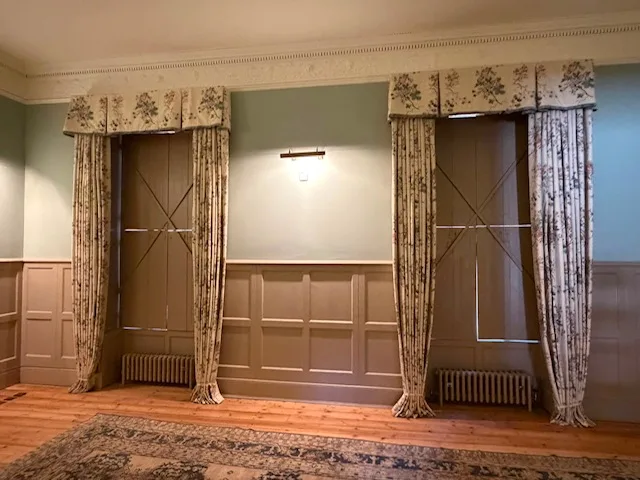
The Victorian townhouse is built for grandeur. High ceilings, deep cornicing, generous bay windows and tall sash windows all call for curtains that hold their own. Short curtains in a Victorian drawing room can feel timid, as though the fabric ran out before it reached the floor.
‘In a Victorian home, floor-length curtains are not just stylish, they are proportionally correct. The architecture demands it. The ceiling height demands it. A puddle in the right room can be absolutely magnificent.’ – Katherine Brown
How Long Should Curtains Be In A Victorian Bay Window?
The bay window in a Victorian reception room is one of the most rewarding curtain projects there is. Curtains that drop to the floor from a well-positioned track or pole frame the bay beautifully and create a sense of warmth and enclosure that shorter curtains simply cannot achieve.
If ceiling height allows, curtains are stunning. But blinds can work too, especially in smaller or more functional rooms. Just make sure there’s space for the curtains to stack back far enough not to block the light during the day.
What Our Clients Say ★★★★★
Great With Awkward Bay Windows
‘Quite aside from the lovely end result throughout the house, I’d heartily recommend Katherine for dealing with awkward bay windows. The suggestion for dealing with them ended up looking great as well as blocking out the light.’
Kerry E, Google review
Renovating A Period Home? Plan The Curtains Early
The features that make period homes special are also what make them difficult: cornices, ceiling height, bay windows, asymmetry. Floors slope, walls bow and window frames aren’t level (I cover how a bounce or puddle disguises uneven floors in How Long Should My Curtains Be?). If you’re renovating, bring your curtain designer in early, ideally before plastering.
‘We can advise on cornice depth, track placement, and how to create recesses for hidden hardware. Even without renovation, a designer helps you get the best result from what you’ve got.’ – Katherine Brown
What Curtain Length Suits An Edwardian Home?
Quick answer: Floor length again, but a gentle break often looks better than a full, dramatic puddle.
Edwardian homes tend to have slightly lower ceilings than their Victorian counterparts, but they still reward curtains that reach the floor. The slightly softer, more domestic scale of an Edwardian interior means a gentle break often looks better than a full dramatic puddle, but it remains a matter of proportion and personal taste.
Katherine’s Key Takeaway
Always consider the floor too, not just the window. If you have beautiful herringbone parquet, you may prefer a clean just-clearing hem that keeps the floor visible. If the floor is less of a feature, a soft puddle can add warmth and character.
Should Curtains Go Floor To Ceiling In A Modern London Flat?
Quick answer: Floor to ceiling, without exception. In a modern apartment with full-height windows, anything shorter works against the architecture.
Contemporary London flats, particularly new builds in areas like Clapham, White City or Canary Wharf, are designed around height and light. Floor-to-ceiling windows are the signature feature, and the curtains should honour that.
Curtains on ceiling-recessed tracks that drop the full height of the room accentuate the ceiling height and create a floating, architectural quality that is very much in keeping with the modern aesthetic. They can be super-stylish, and they also give superior blackout and the flexibility to have the windows open at night. A curtain that stops at mid-height in a room like this would feel arbitrary and miss the point entirely.
Katherine’s Key Takeaway
In an apartment with floor-to-ceiling windows, don’t measure your curtain to the window. Measure it to the ceiling. The curtain should feel like it belongs to the room, not just the window.
If you also need privacy, a second ceiling-fixed track can carry sheer, unlined curtains: a lovely floaty and luxurious look, whilst still letting daylight flood in.
What Our Clients Say ★★★★★
Grown-Up With A Bit Of Cheek
‘She came to our flat and spent time understanding the tone we were going for: grown-up finishes with just a bit of cheek. Katherine took our ideas and ran with them to create something even better than we hoped for.’
Melissa C, Google review
What Curtain Length Works In A Loft Or Top-Floor Conversion?
Quick answer: Honour the ceiling height and the architecture. Original ceiling heights can take full-length curtains beautifully. Low or sloping ceilings are often better with Roman blinds.
Period conversions are more varied. A ground-floor flat with original ceiling heights and cornicing can take full-length curtains beautifully. A top-floor conversion with lower, sloping ceilings may benefit more from Roman blinds or a shorter treatment that works with the architecture rather than against it.
And it’s completely normal for one house to have both. A grand bay window in the living room might have stunning floor-length curtains, whilst the quirky attic bedroom works better with Roman blinds.
Frequently Asked Questions
Can I have floor-length curtains in a bay window?
Usually, yes, if the ceiling height allows. You’ll need space for a curved track or pole, and room for the curtains to stack back onto the walls either side. Sometimes four curtains set around the bay, or a single curtain instead of a pair, works better and gives a more dramatic look.
Does deep cornicing stop me having floor-length curtains?
Not necessarily, but it affects your options. Tracks can often be fitted behind or below cornicing, or we may recommend face-fixing a pole below the cornice line. Every situation is different.
Can I have curtains on a dormer window with sloping walls?
Yes, but it requires careful planning. Drapery arms can be a great way to stack curtains off the window during the day, and a pair of hold-backs can really help to dress curtains back to the wall when open.